Gedakht (Contemplations, 1922)

Der Nister (“The Hidden One,” Pinkhas Kahanovitsh, 1884-1950) wrote mystical folk tales influenced by Rebbe Nakhman of Bratslav. Infused with a secular symbolist melancholy, his stories have been compared to Chagall’s paintings. Gedakht (Contemplations, 1922) was published in Berlin, where Der Nister had gone to escape the political factionalism of the Russian revolution. Invited back to the USSR in the early 1930s, he joined the many Yiddish writers who benefited from the support and endured the surveillance of the Soviet system while attempting to write socialist realism. He was arrested in 1949 and died in a prison camp.

Oksn un motorn

In 1911, Michael Usiskin came to the Jewish settlement of Edenbridge in northeastern Saskatchewan. He and his fellow pioneers struggled with weather, mud, isolation, and the secular/religious tensions they had brought with them, while attempting to maintain a substantive Jewish cultural life in this remote place. Usiskin’s book Oksn un motorn (Oxen and Tractors, Toronto, 1945) tells the story.

What Every Girl Should Know

Yiddish-speaking immigrants to America were intensely involved in every new sociopolitical development, so it’s no wonder (though it is a surprise!) that Margaret Sanger’s What Every Girl Should Know appeared in Yiddish in 1916, the same year it was published in English.

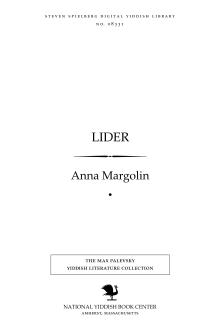
Di festung (The Fortress): Sutzkever's collection of poems

On January 20, 2010, the Yiddish world lost a poet and hero. Born in 1913, Avrom Sutzkever spent his early childhood in Siberia and his youth in Vilna, where he belonged to the Yiddish writers' group Yung Vilne. During the Nazi occupation he used his forced labor detail to smuggle arms into the Vilna Ghetto and rare materials out of the YIVO archive, and documented the conditions of the ghetto in verse. After his escape to the partisans in 1943 he was airlifted to Moscow, and later testified at the Nuremberg trials. In 1947 he moved to Tel Aviv and founded the literary quarterly Di goldene keyt (The Golden Chain, which he edited until 1995). His presence and his work brought new life to Yiddish in Israel, and he is the only Yiddish poet to have received the Israel Prize (1985). View Di festung and other books by Sutzkever in our digital library.

Labzik

Labzik is a dog story by Chaver-Paver (Gershon Einbinder), who managed to make 1930s leftist politics engaging and funny to students of the International Workers Order's Yiddish shuls. Amusingly illustrated by Louis Bunin.

Blonzende shtern (Wandering Stars), v. 1

Sholem Aleichem’s little-known novel Blonzende shtern (Wandering Stars) gives a vivid and gritty portrait of the Yiddish theater in the late 19th and early 20th century. Reizel the poor cantor’s daughter and Leibl the rich man’s son fall in love, but are separated by their careers. Recently translated by Aliza Shevrin.

Yidishe eṭnografye un folḳlor (Yiddish Ethnography and Folklore)

View Abraham Rechtman’s memoir of S. An-Ski’s ethnographic expedition in the Pale of Settlement, with illustrations and photos of old houses, synagogues, gravestones, and folk art motifs.

The Sonnets in Yiddish

Zol ikh farglaykhn dikh tsum zumer-tog? Shall I compare thee to a Summer's Day? The works of Shakespeare fascinated many Yiddish translators. A number of his plays were published in Yiddish, including an alleged Polish edition of a Yiddish King Lear that included the claim fartaytsht un farbesert ("translated and improved") on the title page. You can view or download two translations from our Digital Yiddish Library:  a bilingual edition of the Sonnets, translated by Berl Lapin, who also translated William Blake, Emily Dickinson, and Robert Frost; and a translation by Abraham Asen, who also translated Whitman, Tennyson, Byron, and The Rubaiyyat of Omar Khayyam.
 

Teoretishe un praktishe arifmetik (Theoretical and Practical Arithmetic)

A. B. Rozenshteyn published home-study courses with the Warsaw press Bikher-far-ale ("Books for all") in the early 20th century. His 1909 Teoretishe un praktishe arifmetik (Theoretical and Practical Arithmetic) is not only one of a very few Yiddish math texts, it's surprisingly lively and visually interesting.
 

Manger's "Book of Paradise"

Itsik Manger’s only novel, Di vunderlekhe lebnsbashraybung fun Shemu’el Aba Abervo (The Wonderful Adventures of Shmuel-Aba Abervo) is better known by its subtitle, Dos bukh fun Ganeydn, The Book of Paradise. It’s an irreverent romp (with topical allusions) through the precincts of heaven by two bad-boy angels, Shmuel-Aba and his sidekick Pisherl. They annoy the great personages of the Bible, make a dangerous foray into the Christian heaven next door, and—in Shmuel-Aba’s case—live to tell the tale, by outwitting the drunken angel whose job is to make little angels forget everything before they are born on earth. Charmingly illustrated by Mendl Reyf, the book was originally published in Warsaw in 1939.